
Avoidance - Program
Module 3 — Leaning Into Action
The Shift from Awareness to Action
In Module 1, we explored what avoidance is and how it shows up in our daily lives. In Module 2, we looked deeply at the cost of avoidance, seeing how it robs us of time, energy, opportunities, and peace of mind.
Now, in Module 3, we reach the turning point: shifting from avoidance into action.
This module is all about:
- Breaking the cycle of hesitation and procrastination.
- Learning how to take small, decisive steps.
- Understanding why boring consistency is more transformative than dramatic bursts of effort.
- Building habits of approach rather than avoidance.
If the first two modules were about awareness and motivation, this module is about movement.
Why Action Feels So Hard
Before diving into exercises, it’s important to acknowledge something: action often feels harder than it is.
- Your brain is wired to avoid discomfort. It thinks it’s protecting you.
- Fear, anxiety, boredom, and uncertainty act like red lights that make you stop.
- But here’s the paradox: once you take action, the discomfort usually shrinks, not grows.
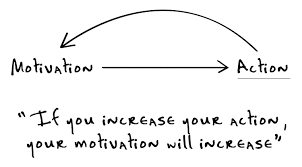
This is called the Action–Motivation Cycle:
- We wait for motivation to act.
- Motivation rarely comes because avoidance drains energy.
- But when we act first, motivation shows up afterwards.
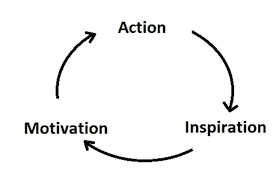
👉 Key takeaway: Don’t wait for motivation. Let action create it.
The Mundanity of Excellence
A core idea in this module is what sociologists Chambliss (1989) called “the mundanity of excellence.”
- Excellence is not about secret hacks, genius-level talent, or sudden breakthroughs.
- It’s about ordinary, repeated actions, done with care, over and over again.
- The boring stuff—showing up, following through, doing the basics—is what creates transformation.
Example:
- Olympic swimmers don’t practice “amazing” new strokes every day. They perfect the ordinary movements—turns, kicks, starts—until they’re flawless.
- In the same way, your avoided tasks—emails, phone calls, planning, exercise—may feel mundane, but mastering them builds the life you want.
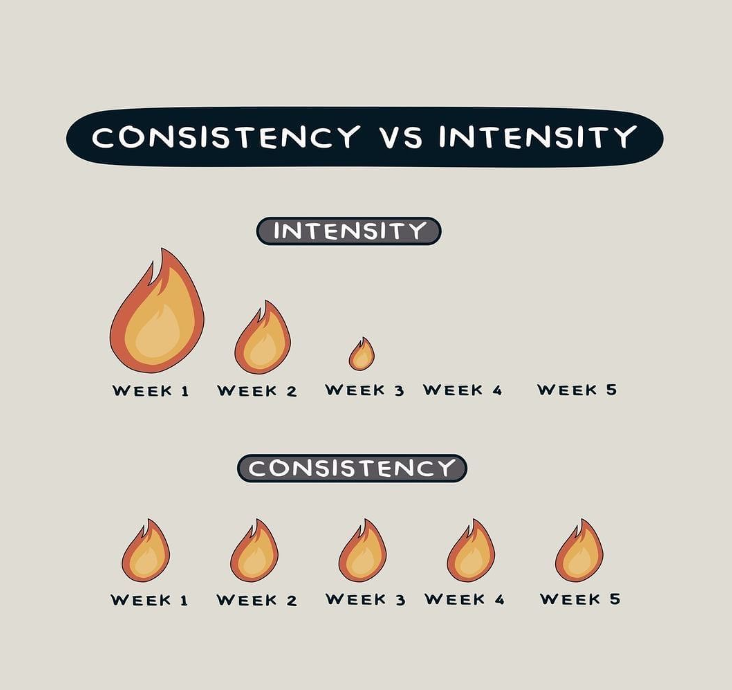
👉 Key takeaway: Consistency > intensity.
The Cycle of Avoidance vs. The Cycle of Action
- Avoidance Cycle: Task → Discomfort → Avoidance → Relief → Guilt → Bigger Task → More Avoidance.
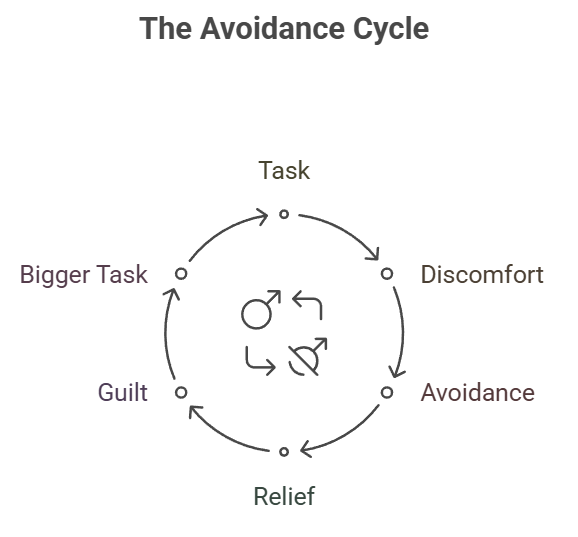
- Action Cycle: Task → Discomfort → Small Step → Momentum → Confidence → Bigger Action → Growth.
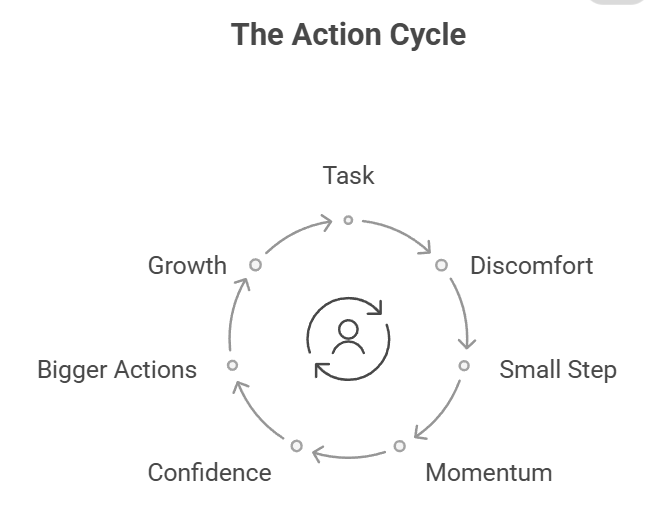
One feeds fear. The other feeds courage.
Exercise 1 — “First Small Step” Challenge
Worksheet: First Small Step
Participants pick one avoided task and answer:
- What’s the smallest step I can take toward this (max 20 mins)?
- When will I do it?
- What obstacles might appear?
- How will I handle them?
- Who can I tell for accountability?
👉 In-session Action Option: If possible, do the step right now. (Send an email, make a list, schedule a call.)
- How did it feel to move from thinking into doing?
- discomfort shrinks after action.
Worksheet Prompts:
- Avoided task: ______
- Smallest step: ______
- When will I do it? ______
- Obstacles: ______
- How I’ll handle them: ______
Exercise 2 — The Consistency Map (30 mins)
Worksheet: The Mundanity Map
- Pick one action to repeat three times this week.
- Write down: Mon / Wed / Fri → When and where you’ll do it.
- Add space to tick after completion and reflect on how it felt.
👉 Reflection prompts:
- What resistance do you expect?
- How will you respond?
- What small reward will you give yourself afterwards?
Share chosen action and consistency plan.
Accountability & Discussion
Avoidance thrives in secrecy. Accountability shines light on avoidance and makes it harder to hide.
How to Participate:
- Share one avoided task you tackled.
- Or share a challenge you faced and how you handled it.
- Use short updates: “✅ Sent the email,” or “❌ Still stuck on call—need help.”
Accountability system:
- Post updates in group chat after each action.
- Share wins, struggles, or just “done ✅.”
- Encourage finding accountability buddies.
Discussion Prompt:
👉 What kind of support would help you stick with your plan this week?
👉 How does accountability change your willingness to take action?
Visualization & Reflection
- “Close your eyes. Imagine yourself consistently taking small steps for the next 30 days. What’s different in your daily life? How do you feel waking up, knowing you follow through?”
- “Now imagine six months later. Who have you become?”
Worksheet: Visualization Journal
- Write 1–2 paragraphs describing:
- What’s easier in your life?
- What emotions do you feel?
- How are your relationships, work, health different?
👉 Reflection: If I kept this up for one year, who would I become?
Closing & Commitments
- Recap key points:
- Action creates motivation.
- Small, boring consistency is the secret to transformation.
- Courage = choosing approach over avoidance.
- Invite each participant to share a one-sentence commitment:
👉 “This week, I will…”
“Avoidance is strong, but your action muscles are stronger. Build them step by step.”
eflection Notes for Module 3
- Discomfort shrinks after action. The fear of doing is worse than the doing itself.
- Small actions are transformative. Don’t underestimate their compounding effect.
- Consistency is power. Your future is built in ordinary, repeated moments.
- Accountability keeps you honest. Sharing with others makes avoidance harder.
- Identity grows through action. Every time you act, you prove to yourself: “I am a doer.”
Integration and Practice
To truly lean into action, practice the following this week:
- Complete the First Small Step challenge. Do one thing you’ve been avoiding today.
- Use the accountability check-ins. Share your wins or struggles in the group.
- Follow your consistency map. Repeat one action three times this week.
- Journal your visualization. Write about the future self you want to become.
Remember: the value of this program is not in the worksheets or lessons—it’s in the actions you take.
Expected Outcomes of Module 3
By the end of this module, you will:
- Recognize the power of small, decisive steps.
- Understand why boring consistency builds transformation.
- Experience the shift from avoidance to approach.
- Build momentum through accountability and action.
Most importantly, you’ll begin to trust yourself as someone who follows through.
Bibliography & References
- Chambliss, D. F. (1989). The Mundanity of Excellence: An Ethnographic Report on Stratification and Olympic Swimmers. Sociological Theory, 7(1), 70–86.
- Baumeister, R. F., & Tierney, J. (2011). Willpower: Rediscovering the Greatest Human Strength. Penguin Press.
- Prochaska, J. O., & DiClemente, C. C. (1994). The Transtheoretical Approach: Crossing Traditional Boundaries of Therapy. Krieger.
- Csikszentmihalyi, M. (1990). Flow: The Psychology of Optimal Experience. Harper & Row.
- Clear, J. (2018). Atomic Habits: An Easy & Proven Way to Build Good Habits & Break Bad Ones. Avery.
- Gollwitzer, P. M. (1999). Implementation Intentions: Strong Effects of Simple Plans. American Psychologist, 54(7), 493–503.
