
Relationships
Understanding Social Circles: Protecting Your Inner Space in a Complex World
In our increasingly interconnected world, it’s easy to blur the lines between who we truly are and how much of ourselves we share in different spaces. This article is based on a conversation that reveals something deeply practical for navigating relationships, trust, and emotional safety: the concept of social circles.
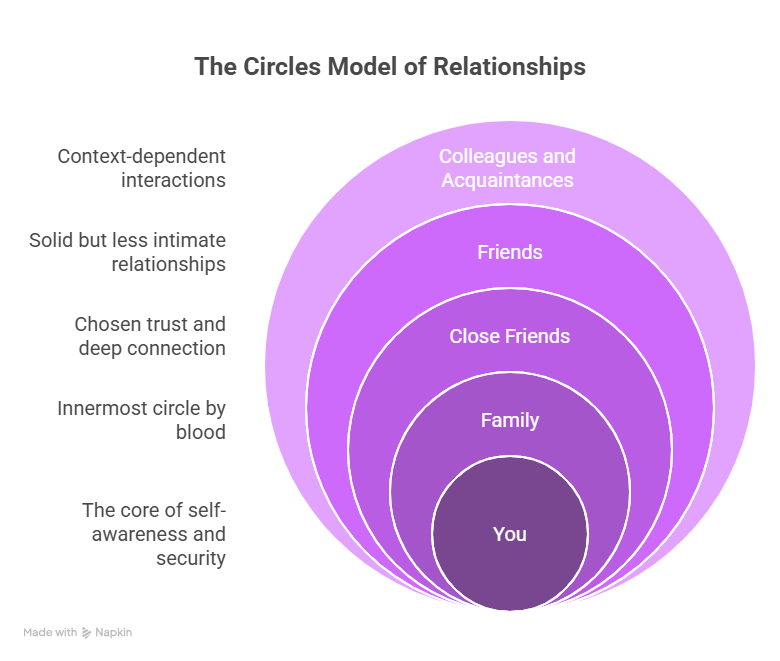
At the heart of your social life is you. You are always at the centre, and around you are layers — concentric circles that help define and protect your identity, energy, and trust.
The Circles Model: A Map of Relationship Boundaries
🟡 1. You (The Centre)
Everything begins here. Self-awareness, self-respect, and emotional security must be rooted in how well you understand yourself and protect your own space.
🔴 2. Family
This is your innermost circle, but also the one you cannot choose. Family is tied to you by blood. They are always there, whether or not the relationship is ideal. You may not always share your whole self here, but their presence in your circle is a given.
🟠 3. Close Friends
This circle is by invitation only. These are people you have chosen to trust based on shared values, attitudes, and consistency of character. Close friends typically don’t exceed more than five people — because deep trust and emotional investment are difficult to sustain with too many.
🟢 4. Friends
These are good, solid relationships, but not ones that carry the same depth as close friends. They might know you to a certain extent but don’t access your vulnerabilities. You might have 20 to 50 people in this wider circle.
🔵 5. Colleagues and Acquaintances
These people may be friendly, warm, or even insightful — but they are not part of your core circle. They are often context-dependent (work, community events, online spaces). The mistake many make is confusing friendliness with trustworthiness.
Why These Circles Matter
The main purpose of these circles is to protect your emotional safety. When you share too much personal information in the wrong space — particularly with acquaintances or colleagues — you risk what is called “leakage.” Leakage refers to unintended self-disclosure, often due to being caught off guard. This can lead to vulnerability being exposed and sometimes even weaponised against you.
People may not always intend harm. But if trust has not yet been built, information can be misunderstood, misused, or gossiped about — especially in social environments where boundaries are blurred.
How to Move Safely Between Spaces
This isn’t about becoming socially isolated. It’s about learning emotional risk management. Here’s how you can practice it:
- Start Small.
If you’re re-entering social spaces after hurt, betrayal, or simply time away, don’t jump in. Attend events with the intention to greet one or two people you already feel safe with. - Ring-Fence Your Conversations.
Avoid personal disclosures in early interactions. Keep things light and general until you assess the space. Practice the phrase:
“That’s something I share with my close circle — but tell me more about your project?” - Control Your Exits.
You don’t have to stay at events until the end. If you’ve shown up, connected briefly, and stayed authentic — that’s enough. Exit gracefully with honesty:
“I came to show face and support, but I’ve got to head to another commitment.” - Practice Discernment, Not Distrust.
The aim is not to live in suspicion. It’s to live with wisdom. Understanding which circle a person belongs in gives you clarity, not fear.
Understanding the Difference: Identity, Personality, and Character
One of the most profound takeaways is the distinction between identity, personality, and character:
- Identity is who you are at your core — your beliefs, values, and vision.
- Personality is how you naturally express yourself — your communication style, energy, and preferences.
- Character is how you act consistently across time and trials — the real evidence of trustworthiness.
In social spaces, especially professional or new settings, we often conflate personality with identity, or worse, reveal identity prematurely without testing character. This model helps break that pattern.
Final Thought
Many people experience burnout, betrayal, or social fatigue not because they are bad at relationships — but because they haven’t yet learned where to place people. Like a house with no walls, everything spills into everything.
By building and maintaining these circles, you’re not being guarded — you’re being wise. You’re allowing connection with intention, and protecting the most valuable asset in your life: your peace.
If this resonates with you, reflect today on who sits where in your circles. And remember, you are always at the centre — and you have the right to decide who enters which space.
📚 Understanding Social Circles: Research and Theory
1. Dunbar’s Number – The Cognitive Limit to Social Relationships
Researcher: Robin Dunbar, British Anthropologist and Evolutionary Psychologist
Core Idea: Humans can maintain about 150 meaningful relationships. These relationships are organized in concentric layers, each representing a deeper level of emotional intimacy and frequency of contact.
Key Circles:
- 5 – Close friends or family (supportive intimacy)
- 15 – Good friends (trusted companions)
- 50 – Friends (people you’d invite to a party)
- 150 – Meaningful contacts (you recognize and know)
- 500 – Acquaintances (name and context)
- 1500+ – Faces you recognize
Source:
- Dunbar, R. I. M. (1992). Neocortex size as a constraint on group size in primates. Journal of Human Evolution, 22(6), 469–493.
- Dunbar, R. I. M. (2010). How many friends does one person need? Dunbar’s Number and other evolutionary quirks. Faber & Faber.
2. Socioemotional Selectivity Theory (SST) – Why We Choose Some Relationships Over Others
Researcher: Laura Carstensen, Stanford University
Core Idea: As people age or become more aware of their limitations (time, energy, emotional capacity), they select relationships that offer emotional satisfaction, not just social utility.
Implication:
- People naturally tighten their social circles over time to focus on emotionally rewarding connections.
Source:
- Carstensen, L. L., Isaacowitz, D. M., & Charles, S. T. (1999). Taking time seriously: A theory of socioemotional selectivity. American Psychologist, 54(3), 165.
3. The Social Convoy Model – Social Support Across the Lifespan
Researchers: Toni Antonucci & Robert Kahn
Core Idea: People travel through life surrounded by a convoy of social relationships that provide support, structured in concentric circles.
Circle Structure:
- Inner circle: Those you cannot imagine life without
- Middle circle: Important but less close
- Outer circle: People you interact with occasionally
Source:
- Antonucci, T. C., Ajrouch, K. J., & Birditt, K. S. (2013). The convoy model: Explaining social relations from a multidisciplinary perspective. The Gerontologist, 54(1), 82–92.
4. Disclosure and Vulnerability Management
Concept: Sharing personal information (self-disclosure) builds trust, but only when done in safe and reciprocal environments. Oversharing too early or in the wrong context leads to emotional risk or exploitation.
Related Theories:
- Social Penetration Theory (Altman & Taylor, 1973) – Intimacy develops through gradual disclosure.
- Boundary Management Theory – Balancing openness and privacy across social roles (e.g., work vs. home).
Sources:
- Altman, I., & Taylor, D. A. (1973). Social penetration: The development of interpersonal relationships. Holt, Rinehart & Winston.
- Petronio, S. (2002). Boundaries of privacy: Dialectics of disclosure. SUNY Press.
5. Leakage and Privacy in Social Environments
In Applied Contexts (e.g. policing, mental health, workplace):
- Information leakage or unintended disclosure is a known phenomenon in interviews and social interactions.
- Vulnerability is exposed when people are not trained in boundary setting, especially in high-pressure or ambiguous environments.
Real-World Application:
- Law enforcement training emphasizes managing what and how information is shared during questioning or casual interaction.
Source:
- Gudjonsson, G. H. (2003). The psychology of interrogations and confessions: A handbook. Wiley.
📌 Summary of Key Takeaways
| Concept | Core Insight | Source |
|---|---|---|
| Dunbar’s Number | Cognitive limits structure social layers | Robin Dunbar |
| SST | Emotional value drives relationship selection | Carstensen et al. |
| Social Convoy | Life-stage and stability affect relationship rings | Antonucci & Kahn |
| Disclosure Theory | Trust is built via staged self-disclosure | Altman & Taylor |
| Leakage/Privacy | Unintentional info sharing can lead to vulnerability | Gudjonsson (law/policing) |
