
Behaviours and Habits
Knowledge vs. Execution: Why You’re Not Losing Weight (and What to Do About It)
“Knowing is not enough; we must apply. Willing is not enough; we must do.” – Johann Wolfgang von Goethe
Recently, a member of our coaching and mentoring group shared an honest reflection:
their weight had gone up slightly—a few kilograms—and they had already identified some behaviours contributing to it. Mostly, it was work-related stress, late-night eating, and comfort eating.
Their question was simple but powerful:
“I want to lose a few kilograms by the end of the year. Do you have any advice, support, or encouragement?”
This response is for them—and for anyone who’s ever found themselves in the same position.
Step 1: Identify the Nature of the Problem
Whenever there’s a goal, objective, or problem—whichever way you want to frame it—it’s helpful to break it down into two categories:
- Knowledge Issue: You don’t know how to do the behaviour that would produce the result.
- Execution Issue: You do know what to do, but you’re not applying it.
Step 2: Understanding the Knowledge Issue
If it’s a knowledge issue, the solution is straightforward: learn what works.
When it comes to weight management, the foundational principle remains simple:
Calories in vs. Calories out.
If you consume more calories than you use, you gain weight. If you consume fewer, you lose weight.
This doesn’t take into account macros (the ratio of proteins, fats, and carbs), but as a starting point, the principle holds true.
Ideally:
- Increase your protein intake (to support muscle and satiety).
- Maintain a balanced level of carbohydrates (to sustain energy).
- Reduce fats, especially processed ones.
But here’s the key—each person’s life, habits, and food environment are unique. Instead of handing out a “perfect” meal plan, it’s often more effective to ask:
“What small changes can you make that would improve the quality of your nutrition while reducing calories?”
“What types of physical movement fit naturally into your current lifestyle?”
These questions shift you from theory to practical, tailored action.
Step 3: The Execution Challenge
“Vision without execution is hallucination.” – Thomas Edison
If knowledge isn’t the issue, then the challenge lies in execution.
Execution must take into account the realities of your life—your workload, family responsibilities, energy levels, and even physical limitations.
Some people can’t do high-intensity workouts or commit to long gym sessions, and that’s fine. The goal isn’t perfection—it’s consistency.
Through a little bit of journaling, reflection, and self-awareness, most people can uncover what’s really stopping them from following through on what they already know would help.
Step 4: The Role of Importance and Motivation
Two deeper aspects shape all this: importance and motivation.
Even when you want to lose weight, it might not be your current priority. Work stress, family matters, or emotional fatigue may consume your energy and attention. In that context, weight loss becomes secondary—not because it’s unimportant, but because it’s competing with other pressing demands.
Motivation is closely tied to perceived importance.
If someone told you your life depended on losing two kilograms within 30 days, your priorities would instantly shift. You’d find time. You’d make time.
Step 5: Clarity Before Action
So here are some key self-reflection questions:
- Is this a knowledge issue?
Do I actually know what I need to do to achieve my goal? - Is this an execution issue?
If I already know what to do, why am I not doing it? - What are my current priorities?
Are there other areas of life taking precedence right now? - What would change if I treated this goal as urgent or essential?
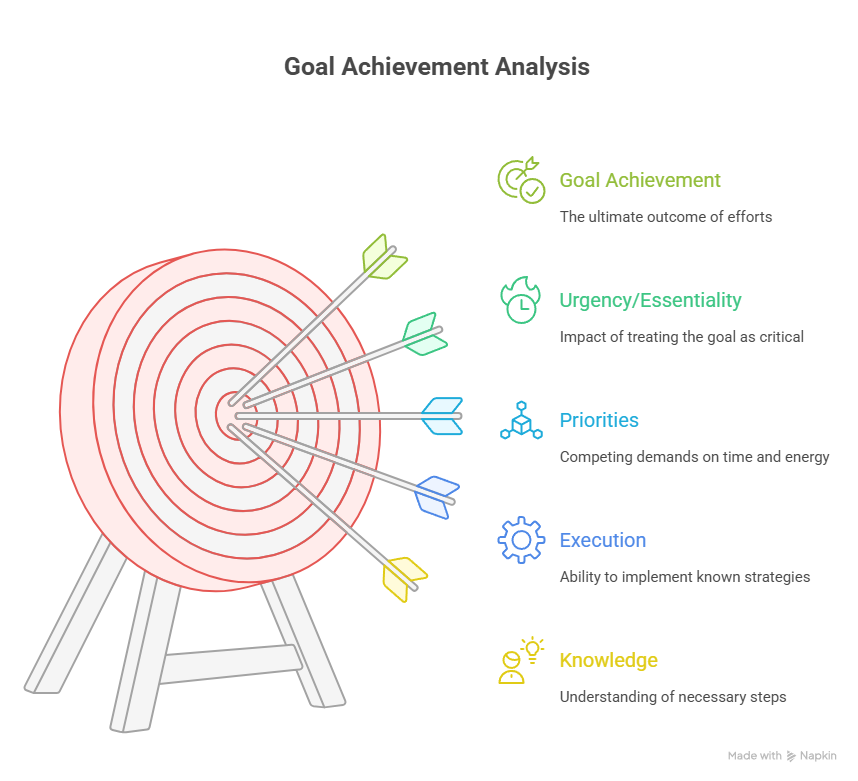
Step 6: The Real Role of Coaching and Accountability
When it comes to coaching and mentoring, people often assume they need more information. But most of the time, what they really need is clarity, alignment, and support—help identifying their true motivations and uncovering their internal or external blocks.
Accountability is not punishment. It’s not about consequence—it’s about consistency.
True accountability simply means keeping track of progress so that weeks don’t slip by unnoticed. It’s a way of maintaining forward movement toward your goals.
As author Peter Drucker famously said:
“What gets measured, gets managed.”
Journal Prompts for Reflection
- What are three small behaviours contributing to my current weight pattern?
- Which of these are knowledge issues, and which are execution issues?
- What’s one small change I could make this week that would have the biggest positive impact?
- What current priorities in my life might be reducing my focus on this goal?
- How can I reframe accountability as support, not judgment?
- If I only had 30 days to achieve my health goal, what would I do differently today?
Final Thought
Improvement rarely comes from more information—it comes from honest self-reflection, small adjustments, and sustained accountability.
You already know more than enough to begin.
Now it’s about doing.
“It’s not the things we don’t know that get us into trouble. It’s the things we know for sure that just ain’t so.” – Mark Twain

Cutting carbs is the best option. I know how to do this. I did it before, but it was difficult! I lost weight but I was hungry a lot! It’s not sustainable – that’s the issue.
I no to do more exercise a d that’s who I m working on now.