
Coaching and Mentoring
End of Year Balance Wheel Comparison Exercise
Introduction: Why Reflection Matters More Than Motivation
As the year draws to a close, many people instinctively reach for resolutions, goals, or ambitious plans for the future. Gyms fill up, notebooks get purchased, and optimism runs high. Yet by February or March, much of that momentum has faded. This isn’t because people lack discipline or desire; it’s because most planning happens without an honest assessment of reality.
The End of Year Balance Wheel Comparison Exercise exists to solve that problem.
Rather than rushing toward change, this exercise invites you to pause, look carefully at where you actually are, and understand how you arrived here. It creates a grounded comparison between the start of the year and the end of the year, helping you see patterns, progress, stagnation, and blind spots with clarity and compassion.
This is not a goal-setting exercise in the traditional sense. It is a sense-making exercise. It helps you orient yourself before deciding where to go next.
By the end of this process, you should not only have a clearer picture of your life across multiple dimensions, but also a deeper understanding of why certain areas improved, why others didn’t, and what realistically needs attention as you move into the coming year.
What Is the Balance Wheel?
The Balance Wheel is a reflective framework that divides life into key categories and asks you to assess how balanced, fulfilled, or functional each area feels.
Visually, it resembles a wheel divided into segments. Each segment represents a life area. When all segments are strong and relatively even, the wheel rolls smoothly. When some areas are neglected or strained, the wheel becomes lopsided, making progress uncomfortable or unstable.
While different versions of the wheel exist, the underlying principle is the same: your life is a system, and stress or stagnation in one area often affects others.
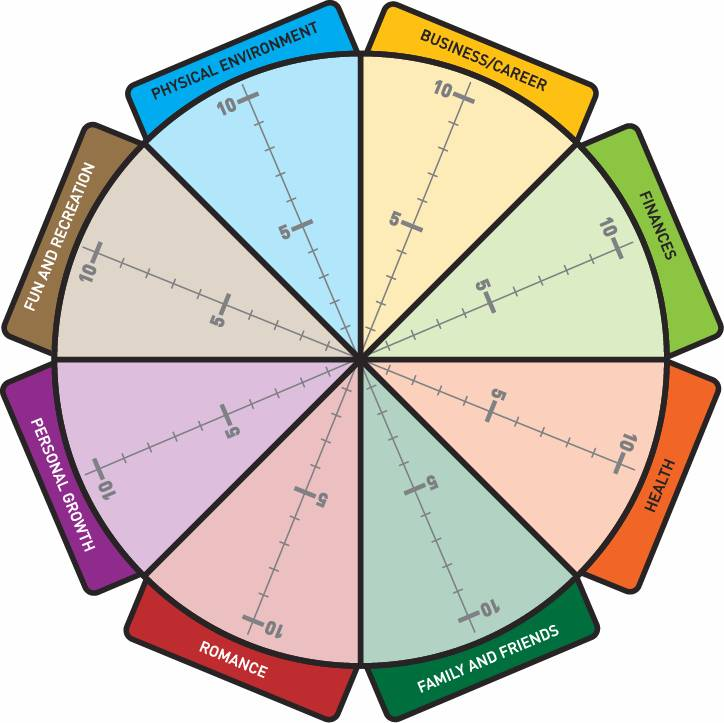
Common Balance Wheel Categories
You may use the following categories, or adapt them to suit your context:
- Physical Health & Energy
- Mental & Emotional Wellbeing
- Work, Career, or Vocation
- Finances & Financial Security
- Relationships (romantic, family, friendships)
- Personal Growth & Learning
- Spirituality, Meaning, or Values
- Home, Environment, and Lifestyle
- Recreation, Joy, and Play
The exact labels matter less than the honesty of your engagement. The goal is not perfection, but clarity.
Part One: Taking a Snapshot of Where You Are Now
Step 1: Rate Each Area as It Is Today
Begin by assessing where you are right now, at the end of the year.
For each category, give yourself a score—typically from 1 to 10—based on how satisfied, stable, or supported you feel in that area. A score of 1 represents deep dissatisfaction or dysfunction. A score of 10 represents a level that feels genuinely strong, sustainable, and aligned.
This step requires restraint. Avoid comparing yourself to others. Avoid rating based on what you wish were true. Rate based on lived experience.
Ask yourself:
- How does this area feel most days?
- Is it draining energy or providing it?
- Does it feel fragile, stable, or thriving?
Step 2: Add Qualitative Commentary
Numbers alone are not enough. After scoring each area, write a short commentary.
This commentary should explore:
- What is working here?
- What feels strained or unresolved?
- What emotions arise when you think about this area?
This is not a performance review. It is a narrative snapshot. You are capturing the story of this area of your life as it currently stands.
Often, the commentary reveals more than the score itself.
Part Two: Comparing Year Start to Year End
Step 3: Revisit the Start of the Year
Now, reflect back to the beginning of the year.
If you completed a similar exercise at the start of the year, refer to it. If not, reconstruct your memory as honestly as possible.
Ask:
- Where was I at the start of the year in this area?
- What was I hoping for then?
- What concerns or challenges were present at that time?
Then assign a starting score for each category, using the same scale.
Step 4: Identify Change, Not Just Outcome
Next, compare your start-of-year score to your end-of-year score.
For each category, note whether you are:
- Better than you were
- Worse than you were
- Roughly the same
But do not stop there.
The real value lies in understanding why change occurred—or didn’t.
Consider:
- What actions did I take (or avoid)?
- What external factors influenced this area?
- What patterns repeated themselves?
- Where did I overestimate or underestimate my capacity?
Progress is not always linear. Sometimes a lower score reflects deeper awareness rather than decline. Sometimes stagnation hides quiet resilience.
Part Three: Recognising Patterns and Themes
Step 5: Look for Cross-Area Connections
Once you’ve compared all categories, step back and look at the wheel as a whole.
Ask yourself:
- Which areas improved together?
- Which areas declined together?
- Is there one area that seems to influence many others?
For example, poor sleep may affect emotional regulation, work performance, and relationships. Financial stress may reduce capacity for growth or joy. Relationship conflict may drain motivation elsewhere.
Life does not operate in silos. This step helps you see your life as an interconnected system rather than a list of separate problems.
Step 6: Identify Repeating Blocks
Across your commentaries, certain obstacles may appear repeatedly.
These might include:
- Avoidance or procrastination
- Overcommitment
- Fear of conflict or change
- Lack of structure or boundaries
- Unresolved emotional wounds
Naming these patterns is not about blame. It is about accuracy. You cannot change what you refuse to see.
Part Four: Understanding Your Current State — Crisis, Comfort, or Creation
Before setting intentions for the future, it’s essential to understand what state you are operating from in each area of your life.
Most people move between three broad states:
Crisis
Crisis occurs when something unresolved—past or present—consumes disproportionate energy.
This may include:
- Trauma or grief
- Health issues
- Financial instability
- Relationship breakdowns
- Chronic stress or burnout
In crisis, forward planning feels overwhelming because the nervous system is focused on survival.
Comfort
Comfort is not necessarily happiness. It is familiarity.
In comfort, things are stable enough that change feels optional, but dissatisfaction lingers beneath the surface.
Comfort often hides behind thoughts like:
- “It’s not that bad.”
- “I’ll deal with it later.”
- “At least it’s predictable.”
Comfort can quietly limit growth.
Creation
Creation is the state in which you have enough stability and capacity to build something new.
Here, the challenge is not survival or stagnation, but clarity, commitment, and follow-through.
Understanding which state applies to each life area prevents unrealistic expectations and self-judgment.
Part Five: What Is Actually Stopping You?
Step 7: Distinguish Internal vs External Barriers
For each area you want to improve, ask:
- What external factors are genuinely limiting me?
- What internal factors am I avoiding or underestimating?
External barriers may include time constraints, financial limits, caregiving responsibilities, or systemic issues.
Internal barriers often include fear, belief systems, emotional avoidance, or identity conflicts.
Both matter. Confusing one for the other leads to frustration.
Step 8: Name the Cost of Not Changing
Often, people focus only on the discomfort of change, not the cost of staying the same.
For each area, reflect:
- What will this look like in 1–3 years if nothing changes?
- What quiet costs am I already paying?
This step builds motivation grounded in reality rather than pressure.
Part Six: Setting Intentions, Not Overambitious Goals
Step 9: Choose Fewer, Deeper Focus Areas
Resist the urge to fix everything.
Choose one to three areas where intentional effort would have the greatest ripple effect.
Ask:
- Which areas feel most alive or urgent?
- Where would small changes create meaningful relief or growth?
Step 10: Define Intentions Aligned With Your State
Intentions should match your current capacity.
In crisis, intentions may focus on stabilisation and support.
In comfort, intentions may focus on gentle disruption or experimentation.
In creation, intentions may focus on structure, consistency, and momentum.
An intention is not a demand. It is a direction.
Part Seven: Carrying This Forward Into the New Year
This exercise is not meant to end in December.
Consider revisiting your Balance Wheel quarterly or biannually. The value compounds over time as you build self-awareness and pattern recognition.
Use your insights as a compass, not a weapon.
Growth that lasts is rarely dramatic. It is usually quiet, cumulative, and deeply personal.
Conclusion: From Reflection to Intention
The End of Year Balance Wheel Comparison Exercise is not about judging your year as “good” or “bad.” It is about understanding it.
By comparing where you began and where you are now, you reclaim authorship over your narrative. You stop outsourcing your sense of progress to external markers and start relating to your life as a dynamic, evolving system.
When reflection precedes intention, change becomes sustainable rather than performative.
As you move into the next year, carry forward not just goals, but insight. Not just motivation, but clarity.
That is how real, grounded progress is made.

This is really good; I still have mine from previously. Do you have the same blank copy so that I can use the same one to write on the wheel itself please?
I have looked over it, the themes I have now are similar, but I will fill it out in more detail. I can’t find a sheet the same though. Thanks.
Step 5 very interesting – My family and friendship relationships are very important and directly affect emotional health. I can go a long time not seeing anyone on my days off and it’s not healthy, this is the part I wish to fix to an extent, but I lack a structure to do this at present and rest is also an issue. Structure is an area to work on for me.